Play Guide 1: Fun ways to train children’s vestibular sense
The vestibular sense is one of your child’s three primary senses. The other two are proprioception (the body awareness sense) and the tactile sense (also called the sense of touch).
Our precious kiddos have lots of nicknames, and so do their senses. The vestibular sense is also known as equilibrioception or the sense of balance.
Here is the first of our three Play Guides on strengthening your child’s motor skills. Read along and get our ideas for fun games that stimulate your child’s vestibular sense.
Toy Academy Play Guides offer:
- Fun, easy, no-fuss activities
- Inspiration and advice from psychomotor and sensorimotor professionals
- Tips on promoting your child’s learning and well-being
What is the vestibular sense?
The vestibular sense ensures that the brain knows where we are, vertically, horizontally, and diagonally. All children (and adults) need regular stimulation of the vestibular sense.
Along with the other primary senses, the vestibular sense is at the core of our overall motor development. It serves to create balance and concentration skills. It also plays a significant role in language development and affects eye control.

Why is the vestibular sense important?
The vestibular sense is closely connected to our vision. It helps us create a stable focal point while moving our eyes and head and maintain a steady field of vision. In practice, this means that we are able to keep our eyes focused while we’re moving, so the things we are looking at do not blur or flicker. This development is particularly important for kids who are learning to read and write.
Physically inactive children and adults who spend most of their days sitting often lack vestibular stimulation and can greatly benefit from actively stimulating and challenging their vestibular sense.
Do I need to train my child’s vestibular sense?
 Have you noticed that your child doesn’t like to swing, has trouble standing on one leg, doesn’t enjoy spinning, easily gets car sick, or has trouble keeping their balance? If so, you can really help your little one out by strengthening their vestibular sense.
Your child’s difficulties are likely limiting their well-being and ability to learn, because the brain has to work overtime when it receives inaccurate vestibular input.
Play Guide 1: How to train your child’s vestibular sense
1: Use a giant top to get your child used to spinning. Any rotation may feel overwhelming for a child with sensorimotor difficulties, so be careful at first. You may want to start with a flat-based giant top or a mini top.
If you’re not looking to spend money, you can use a bed sheet: have your child sit or lie on the sheet while you hold on to one end and run circles around them.
2: Use colourful and noisy toys, such as an Oball rattle or an egg shaker, to encourage your child to look in many different directions, both while lying on their stomach and their back. You can also fill a plastic bottle with pebbles and roll it across the floor.
Having your child turn their head in many different directions is a great workout for their vestibular sense. It helps the brain understand the body’s spatial position while maintaining horizontal, vertical, and diagonal balance.
3: Build lots of obstacle and balance courses in your home using creative toys from Gonge and bObles. You can also use couch cushions, scarves, low chairs, and swings if you prefer. Psst: Walking on a line is also a great balancing exercise for us lazy adults.
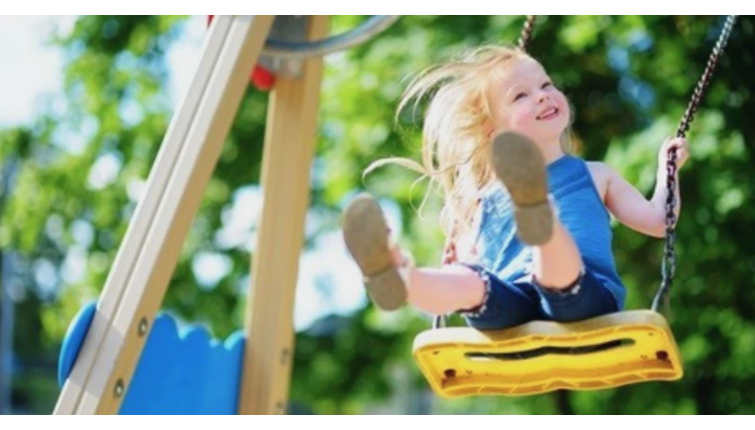
Don't forget to swing, spin, do rolls, somersaults, and cartwheels, crawl, jump, and run to your hearts’ content. All of those are excellent training for the vestibular sense. Remember to have fun, and go for a spin or a swing with your child if you can! Swings are probably the world’s best tools for training the vestibular sense, whether you’re a baby or a senior. Swings are great for everyone, from the moment we’re born until we’re too old and tired to get on one.

An overstimulated vestibular sense?
Please be aware that it is possible to overstimulate the vestibular system.
The symptoms of an overstimulated vestibular system actually tend to be the same as those of an understimulated one: your child may feel unwell, dizzy, nauseous, or car sick.
If your child starts feeling sick or woozy, for example when spinning around, it’s a good idea to take a break. That doesn’t mean you should stop stimulating the vestibular sense altogether. Just slow down a bit and maybe do a few gentle forward rolls instead before gradually introducing more movement and speed.
We hope that this Toy Academy Play Guide, and the next three, will give you:
- A better understanding of your child’s senses
- A challenge to your usual way of understanding your child’s well-being
- A solution to sensorimotor difficulties
- Tips for boosting a sense that is crucial for your child’s learning abilities and self-esteem
Play Guide 2 deals with proprioception (movement)
Play Guide 3 deals with tactile stimulation (the sense of touch)
Play Guide 4 offers tips for developing fine and gross motor skills